Sunday, July 17, 2016

The Salkantay Trek - The 2nd Hardest Day

Day 7
Tuesday July 12

Four hours of hiking along a steady incline. Today KD and I wondered why we decided to do 4 straight days of hiking straight uphill and straight downhill. But, we didn't harbor such thoughts for long. There was still too much walking to do before reaching Machu Picchu.

Our trek up the Incan steps

The track is narrow. We march single file through unusually high temperatures to the Llactapata Inca Site where we'll get our first really good view of Machu Picchu. And here it is:

KD and PC with Machu Picchu in the background
We meet a Czech hiker along the trail who has been traveling for 6 months. He is worried because he only has 2 months left of travel. We need a Czech vacation ethic in the US.

Our trek takes us to a small, family owned coffee farm where we roast, grind, and brew the beans ourselves. All we needed to do was pick them to round out the coffee adventure. Anyone who knows me knows how I feel about coffee (and how coffee feels about me - usually ending up on my shirt, pants, the ground ... but I do end up drinking most of it). The farm was completely sustainable, entirely organic. No pesticides, herbicides, or insecticides. The entire family works the farm and no one else. It's a labor of love that occupies all their time.

Plump red coffee beans ripe for the picking - it's harvest time in Peru

You can't escape Starbucks even in the Andes (this a joke, by the way)
KD roasting those beans good
PC grinding up the beans

Cuys (guinea pigs) scrabble around in their shed. I'm challenged to catch one. I try. I fail at first. Then, the woman who owns the farm drops some coffee leaves. The cuys stop crying and eat. Now it's like taking candy from a baby.

Cuy cuy cuy
The fruits and vegetables grow plentifully, and wildly, long the trail. We see the Yucca plant, a wild ancestor of the tomato, bananas, passion fruit, avocados, and of course lots of coffee.

Yes, we have some bananas
KD and I are absolutely filthy. Even though we weren't expecting it, we end up in a campground located in a hot springs near Hidroelectrica, or the last point before the walk to Aguas Calientes or Machu Picchu Pueblo (the last town before Machu Picchu). European tour groups are drinking a lot of beer and throwing themselves in the hot springs (which are only lukewarm). The hot springs closes down and the Europeans scatter to their minibuses.

The not so hot hot springs 
We eat dinner with our trek squad. Julio, the cook, has 2 boys and a girl. Valentino has 3 boys. The dinner is really solid. Before long, our hardworking trek squad are back at work.

Now, one more day until we are within striking distance of Machu Picchu.

Best,
PC

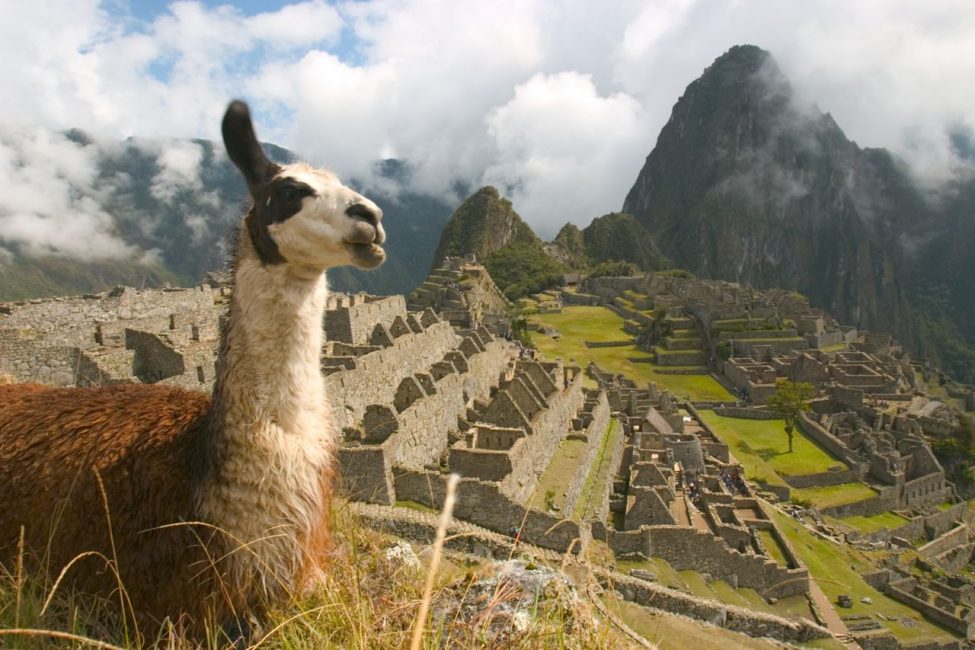
Looks like a stock Google image, but I took this photo (seriously) 

Salkantay Trek - The Longest Day

Day 6
Salkantay Trail

The longest day of hiking.

Wake up in a beautiful campsite surrounded by the snowy summits of the San Miguel range - Humantay and Salkantay reign supreme.

The view down the trail

Our campsite as seen from the trail
Along the trail we learned about Alpaca Expeditions sustainable practices:

  • Porters, cooks, and waiters are all hired from the poorest districts - they all have limited access to an education or skilled jobs 
  • A lot of folks are hired - some seasonally, some permanently (approximately 70 guides, 70 cooks, and 140 porters) 
  • Wages paid by Alpaca far exceed the traditional earnings from day labor, farming, or in local stores 
  • Proceeds from treks go in part to pay for sustainable development projects - for example, money from previous treks was used to purchase a classroom set of computers for a school 
  • All produce purchased from local markets 
  • All cooking utensils, cookware, silverware, and dining ware is reusable - nothing plastic, nothing styrofoam 
  • All water boiled from local sources for drinking and cooking 
  • All waste packed and packed out
  • Visit and support local sustainable businesses along the trek like a coffee plantation where we purchased beans 
Our amazing trek squad

A lot of downhill walking - some near vertical stretches. 
We travel down and way from the mountains, leaving the Andean high alpine for the low alpine 
Flowers blossom in the southern equatorial winter. 

This flower is called colloquially the "corn flower" - it looks like corn
Birds sing (the first we see is a small flock of parakeets) 
The temperature rises. Our layers peel off. 

KD and PC - happy to be warm again
We pass through a small village where we see every type of domesticated animal: 
  • A cow milked awkwardly by two very uncomfortable men
  • Spotted ducks 
  • Dogs of all breeds, sizes
  • Turkeys 
  • Chickens and roosters
  • Pigs (the day before we saw a dog pulling a pig by a leash) 
  • Sheep 
This puppy doesn't know why those ducks won't leave him alone.
We camp at La Playa and share the campground with a group of American students who are surprisingly quiet. Still can't sleep. Water from a nearby river gushes all night. The stars fill the sky. I see a llama constellation. 

Until the next post ... only two more days to Machu Picchu. 

Best,
PC 

Saturday, July 16, 2016

The Salkantay Trek to Machu Picchu - The Hardest Day


Day 5
Santa Theresa, Peru
The Salkantay Trek to Machu Picchu


The following entries will be short dispatches with an emphasis on images rather than words. For the APES students out there, let me know what you think about the images. Bonus points next fall if you can name the biomes and ecosystems I'm passing through (though I may give a few too many hints):


Dispatch 1 - Sunday 7/10
Depart Cusco at 4am and arrive at our trek's starting point, which is known as Soraypampa for our first 3 hour hike.


Prepping from the trek 

Breathe. Walk. Breathe. Walk. In through the nose, out through the mouth. Sip water. Breathe. Walk. The elevation gain hits you suddenly. Cusco was 11,000 feet and now we're quickly ascending from 12,000 to 13,000 and eventually up to 15,000 feet.

The trail ahead 


Our trek guide tells us that 5 years ago the glaciers on the Andean mountains to our right and left extended down to where we are hiking. The glaciers are in retreat. Terminal moraines are visible in all directions. Till slips down the mountain sides.


Name the geologic feature .. hint, I mentioned it in the text 


The winds whip and the trail steepens. We reach the top of the mountain pass - elevation 15,157 feet. It's a little easier to breathe. The view gives oxygen instead of taking it away.

PC and KD at the top of the Salkantay Pass 

That's all for now. More dispatches to come.


PC

Friday, July 15, 2016

Vive La Paz

Day 10

La Paz is not Bolivia's actual capital.


La Paz, the 2nd Capital of Bolivia as viewed from the Teleferonica (or Sky Rail)

It's Sucre. I didn't know that until today. Even though the legislative and executive branches of government are in La Paz, it's not the capital. Anyway, today is La Paz Day. The streets are packed. Music is bumping out of every window. Meat is being grilled. A kid in a purple mariachi costume is singing ballads off key. It's great.


La Paz Day Festivities - raged on until 4:30am (our hotel was only a block away)

It's been a long few days. Lots of 3am to 4:30am wake-up calls. More images on Cusco and Machu Picchu starting tomorrow.


Best,

PC 

Thursday, July 7, 2016

Day 1 
July 6
Lima, Peru

Bienvenidos a Peru! 

On day one, July 6th, we took a city tour of Limas. Like Manhattan minus the subways and public buses, Lima is awash in taxis. On the sustainability score card (which I will be tracking from here on out), Lima loses puntos (-10). There are collectivos and privately run buses, but their routes contradict one another, therefore leading to much congestion. 

First, we dropped by the Museo Larco, a beautiful repository for Pre-Colombian art work. You forget that you're in a city of 9 million behind it's flowered gates and in the midst of its lush garden. The artwork conveyed a deep connection to the Pacha Mama and united the entire country. The museum did not hide from the country's brutal past. Paintings from the Spanish conquest period showed how Spanish attempted to ingrain their injustice in the Incas and other indigenous groups through works of art. One in particular depicted the line of kings and showed how the Incan rulers "naturally" transitioned into the Spanish kings. 


This couple did a lot of laps around the Plaza de Armas. 
We hopped in another cab (no more demerits at this point) to downtown Lima. We wound our way through the Plaza de Armas and onto the grounds of the Catedral de Lima. The pigeons dive-bombed a fountain while sales people hocked their wares - pushy, but not too pushy. 


The Casa de Literatura stood out today. A converted train station, the museum was wedged between the Catedral de Lima and the Basilica de San Francisco, two much more well known tourist sites. The museum is dedicated to hands-on learning and has a very strong community feel. High school and university students sat on picnic benches on the back patio sketching and writing. Inside, a library dedicated to Mario Vargas Llosa, a Nobel Prize winning Peruvian author, served as a quiet reading space for locals and tourists alike. Reading and writing have a deep connection to Peruvian culture. We witnessed many libraries and book exchanges along our day tour. But, what really set this museum apart was the hands-on nature of its exhibits as well as accessibility of the didactic material. The art work took on a message of inclusion and political debate as well as tolerance for Peru's wide array of cultures and languages. I took away a number of ideas from the museum regarding how to embed social and environmental justice through writing modules in the APES class. 


Revolutionary art in La Casa de Literatura


Revolutionary writing is an urgent matter
The final stop of the day was the Basilica y Iglesia San Francisco. We viewed the 16th century artwork and toured the courtyard. Franciscan monks walked around, going about their business, which added to the historical ambiance. The end of tour took us into the catacombs where 25,000 Franciscan monks and their novices (apprentices) were buried in large cubical containers within the crypt. No photos were allowed, but let me tell you, the dim lighting and low ceilings and the thousands of bones made it the perfect Halloween stop. 

We ate dinner that night with two Fund for Teachers Fellows from Kansas City. We walked around Miraflores and enjoyed an outside meal. 

Day 2
July 7th
Lima, Peru

The day started off on a bad note. A meeting I had with representatives from Grupo GEA was cancelled. Grupo GEA is a non-profit consulting group that supports sustainable development projects in Peru. I was hoping to see their project called Esoescuela, which is an environmental education program in Lima schools. But, I will correspond with their representatives and will conduct an interview by phone later on during the trip. 

But, we did see some examples of sustainable development work.  Lima is a very clean city. There are trash barrels everywhere and a robust recycling system. Plus 5 for Lima on the sustainability scorecard. I also saw a netting system to prevent rockfalls along the coast.  The netting covered every square inch of the very loose, conglomerate rock that makes up the cliffs. Plus 5 for Lima. That brings Lima to a neutral sustainability score for the two days. 
I took a lot of strange looks for posing in front of this grocery store's recycling center


The netting system around the rocky conglomerate cliffs. 
We took an urban hike down to the beach called Larco del Mar. Post beach, we hopped in yet another cab and made our way to the airport. Cusco is next. My next blog post will come after a few days. Only 2 more days to Machu Picchu! 

Buenos noches a todos. 

Sunday, July 3, 2016

Peru - Tuesday July 5th


Environmental Scientists,

I am off to Peru on Tuesday to do some research for an environmental justice unit that will be a part of your APES class in the fall. Please follow my adventures and post comments. In addition, you should post your summer adventures or share a story that has anything to do with human health or the environment.

Have a great summer and see you in September.

Best,
Mr. Callahan

Image from: http://theplanetd.com/images/peru-machu-picchu-llama.jpg 

Monday, March 28, 2016

The Battle for Land ... and Water

Listen to the podcast ... http://www.npr.org/sections/parallels/2015/03/12/392323822/the-west-bank-battle-for-land-and-water ... and read the article. 

Write a response to the following: 

(1) What is the land and water crisis in the West Bank? 
(2) How is the political problem now an environmental problem? 
(3) Why do issues like this persist around the world? Cite another example of a place in the world where water and land and politics and culture are colliding? Conduct some research and write up a brief description here.