Friday, September 2, 2016

Granada Nicaragua 2016!

(Apoyo Lagoon Natural Reserve)

This day was our last day working on our CAP (Community Action Project). It was one of the most emotional days. Looking back to this day I remember the smiles and laughs of all the kids while playing with the pinatas as well as when we presented them with all the school supplies that we donated them with. It was a day that we celebrated all of our hard work on La Escuela Inmaculada. Many of us painted the school, this was to enhance the appearance of the school. Other Glimpsers worked on crafting cement in order to renovate the playground and make a pathway to the kitchen. This helped the school transform into a safe environment for the kids. After this, the leadership team had a surprise for us. This surprise is shown in the picture above. This place was one of the most beautiful places I've ever seen. It had a beautiful view of the lagoon that we were able to swim in. This view took my breathe away. It was something that I knew i had to cherish because of the complete difference in environment between Nicaragua and New York. That's some of the unfortunate things about NYC, because NYC is a city the only time I see nature is central park and the Hudson River that I can see from apartment window. 

                                                                  (La Casa de Comedia)
         
        This picture shows the house of comedy. This house is a special house with an important purpose. This house is made out of about 20,000 PLASTIC AND GLASS BOTTLES. This house was so beautiful and fascinating. The people who live there work in a circus and create an atmosphere that makes it feel like a home filled with love and joy. They even have a couch made out of plastic bottles, which is actually comfortable (they put cushions on top). One of the residents of this house explained to us that in Nicaragua, water is very sacred. There is also a big trash problem in Nicaragua. I got to experience this problem while being in Nicaragua. This meant closing the water while I was brushing my teeth when it was not needed. I also saw how there was almost no trash cans in the streets. This trash sometimes end up in the rivers which effect people lives. This house relieved some of that problem. One of residents of the house also told us how he reached some of the kids on how to recycle and reuse. For example he turned a pack of gum box into a wallet. After our tour of the house we were able to learn circus tricks. The best thing was doing aerobics, however juggling was challenge for me because I can't even catch and yoga was difficult because of the heat.                                


            This is one of the designs of the bottle house. This house is a two story house filled with beautiful art and amazingly kind people.

Thursday, September 1, 2016

Summer 2016


   My summer this year was total different than what I had planned. Everything I had planned most likely will take place next summer. However my summer was actually quite fun. I got to do a lot of things I wanted to do for a long time, meet some amazing people and sleep alot. Time flies, it's hard to believe school starts next week.
     It occurred to me that during the summer I tend to eat the most unhealthy foods. Based on the New York Times researcher speculated that children put on weight more quickly over summer vacation for reasons that might also explain why adults eat more on the weekend and gain weight faster during the holidays. During the school year were more focuse in passing our classes that we don't eat as much as we would if we had nothing to do. Beside the increase of unhealthy food eating during summer,  the weather was something else. It was incredibly hot. So the Air conditioner was definitely on all day if I was home. Recent research has shown that average summer temperatures post-2050 will regularly top today’s records. It's clear that this is an effect of global warming.
   I saw my schedule today and for someone who loves science I'm glad I have 3 period just for it. I ready to start this school year. The summer was a blast but in a week it's back to getting in mindset of school.

Wednesday, August 31, 2016

What I Learned about Life

I know the title of this seems a bit off-putting but I think it would be best if I were to explain everything I've learned throughout the summer, especially throughout the Heckscher Pre-College program.
My sister, my dad, and my mom at the park
My dad attempting to look cool
This summer I've gone to Dorney Park with my family along with another friend. We had a great time there and spent a few hours getting on a few rides and going to the Wave Pool. I personally only went on one roller coaster ride because of my intense fear of them. It was possibly the scariest experience I've had because of how unsafe I felt.

I didn't do much else this summer except spend some time with my friend's and family. I don't suppose I had the most exciting summer but it was definitely enjoyable.

I started off with the Heckscher program thinking the college process was going to be easy. It is quite simple but it put the realization into my head as to the fact that we're all growing up extremely fast. It feels as though just yesterday we were all freshmen. I'm happy with where I am in terms of my social and academic life because it's transitioned into a healthy lifestyle compared to my middle school experience.

I am hopeful that the college process will be much more easy-going and will be rewarding more than ever because of the amount of hard work that everyone has put in.

Sunday, August 28, 2016

All Around Summer 16

         This summer I had many different opportunities and jobs presented to me. During the month of July I was an intern with Build-on (unpaid) and I was placed in Bryant Hill Community Garden with two other interns. In this program, me and the two other interns went every Tuesday and Thursday to help the garden leader Lucia around the garden. During the month of August I began to work at  Lamont Doherty Earth Observatory. This is a program at with Columbia University where teams were set up and given a group leader with a specific task and working on the Hudson River to gather information that would help them towards their goal.
         At the garden me and my other teammates saw that the garden wasn't in the best condition and we wanted to help bring up the environment because we learned how important a community garden actually is. We learned that how a community garden not only helps make the environment more beautiful but actually helps people in nutrition. While we were in the garden we began to do little things like pack things up, tidy up around the garden, pull weeds and more. But later we got to have a much better experience because the group leader began to explain to us all the things that a garden can do for a community. Like this garden specifically lets children come in certain days to help garden and get a better experience with plants and nature, mainly because this is more of a natural garden where the terrain isn't leveled like most gardens you would see. During this time we also learned how to collect honey and plant properly. Lately the garden had a gazebo put in the center but didn't have proper stairs so what we did was help put some into place so it would be easier to access.
         Me and my teammates also saw the garden needed more help then just a few kids in one summer so me and my teammates had some ideas. One idea was that we have kids from the AP Environmental class go during the school year at least once a month to help bring-up the garden. We also talked about how we can have a section in school programs such as day for children where we can talk about the garden and how it can be used to help people and pitch new ideas to the community.
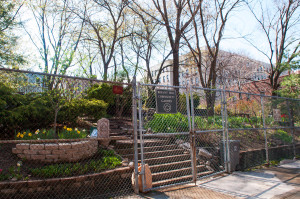
This is a picture of the garden, but not while we were there.

        During the month of August I worked with SSFRP program that had 9 teams each with a different task at their disposal. I was placed into the nutrients team. Marsh ecosystems are important modifiers of nutrients from sewage and agricultural runoff. Piermont Marsh, a brackish tidal marsh located in the lower Hudson River Estuary, is an irregularly inundated wetland system with two tidal creeks and one freshwater creek. My teams objective during this summer was to determine which nutrients have a river source or a marsh source. This means that we were trying to establish weather were nutrients coming in or out of the Hudson. We did this by measuring the marsh nutrient cycle  in 30 minute intervals. Water samples and sensor data (DO%, and Salinity) were collected for nutrients (nitrate, nitrite, phosphate, and ammonium). Our data research shows the marsh appears to be a significant consumer of nitrate during the summer and a source of phosphate to the adjacent river water.
We also had to collect all the data and analyze it and put it all on a poster to present in front of everyone who participated in the program and some scientist.
This is our team and the process we have done thought the summer
I feel like this program has opened my eyes because I honestly learned so much new things and i had a better environment to do it in. This program was more self guided and most independent. It is different from my other experiences because I was always told what to do, in this program they gave you the materials and you and your team had to come up with the solution. Of course we had our own scientist that helped us through the process but he helped us in the way that he was woking next to us not on-top of us. He made it seem like everyones part in the research was equal to his. This experience has been very eye opening and fun for me. Made me think I don't mind doing work like this for the rest of my life.

If you would like to see more pictures of the program check out the SSFRP page on Facebook. This is the first time that this has been used for the program and they are hoping it is used more while the program begins to continue and progress.

Friday, August 26, 2016

GG 2016: Granada, Nicaragua

Behind me is the beautiful city of Granada!

This summer I was able to have the best experience of my life. I was part of a program called Global Glimpse which allowed me to travel to another country for 2.5 weeks. I travelled with 20 other students to Nicaragua. There were students coming from different places in the US which were New York, Seattle, Boston, and Philadelphia. We all joined together and stayed in the beautiful city of Granada. In Granada, I was able to experience the most amazing culture and I was able to admire what nature has to offer. In my time over there I witnessed many things that made me look at the world in a different perspective and how I can make a change in the world no matter how big or small the change is.

Each day I would be so excited to wake up and find out what the new adventure would be. My favorite days on this trip was Culture Day and our Free Day #2. On Culture Day, my group and I visited a few people who used their talent to embrace the Nicaraguan culture and share it with others who wanted to learn about this incredible culture. The first person we visited was a lady who had a business of making and selling maracas. She showed us the process of how to make maracas and she even let us create some maracas and paint them as well. At the end of her demonstration she surprised us with 2 maracas for each person and all the maracas had our names and Nicaragua engraved. Once we left the lady we went to a man who was a famous artist in Nicaragua. His specialty is pottery. He does all types of pottery with the help of his remarkable family. He gave us a demonstration on the process of pottery and what you need to do in order to make the perfect pot. At the end of the demonstration the man surprised us with our own little pots which we were able to paint and take home as a memory. He also let us experience the process of pottery by letting us create our own pot which was very messy but a lot of fun. That day we were all saying that it felt like Christmas because we received many gifts that we will cherish forever. On Free Day #2, we were able to explore the city of Granada and we even see a volcano! I was so surprised to see a volcano because I have never seen one and I didn't think I was going to see one on this trip. We were able to see the volcano erupt a little bit and we saw real lava. It will be something that I'll never forget because I never thought in my life I would experience this and this summer it was the experience of a lifetime.

My amazing maracas!


El Volcan Masaya!

Monday, August 22, 2016

Gardening Experience

To start off this blog, I want to talk about what I've been doing in this month of July.

I've been volunteering at the Bryant Hill Community Garden with two other interns. I am a part of the buildOn summer internship (unpaid I should say). buildOn is a nonprofit organization focused on helping students earn service hours and giving back to not just the community, but the world. So I was lucky enough to become a part of this internship and I decided to give back to the community by volunteering at the Bryant Hill Community Garden located in the Bronx.

When I began volunteering at the garden, I saw that a lot of changes needed to be made and I had a strange urge to really help this garden grow. Not a lot of communities have access to gardens or healthy foods. My supervisor takes care of the garden mostly by herself. Occasionally groups like buildOn come to help, but they can only come so often. Working at the garden has made me realized that changes have to be made because no one else is going to do it themselves.

Before I get into some ideas I have for improving the garden, I'm going to first talk about what I've been doing so far in the garden.

There are many tasks to be done and it is not always easy. My supervisor had recently had a gazebo put in the garden, however we had to fix the steps because it was not leveled. So I, along with another intern, had to mix the cement and stir it. We also had to put new brick steps and cement it, which is very tenuous because bricks are heavy and the cement dried fast, so we had to be quick and lay down the bricks before the cement dried up. It took about two or three hours to get the job done. I can assure you that being a construction worker is not on my career list.

One day we made honey that my supervisor collected from the bees. I expected making honey to be easy, but it's not easy. The bees cover their honey with bees wax and you have to slice the bee caps off, which takes a lot of patience and work. Then, you have to put the frames in a machine and with a handle the machine is collecting the honey off of the frames. Once that finishes, you strain the honey so that no bees wax or pieces are in it. And that's basically it. But it takes hours just to collect a pound of honey and if you're not a fitness person, then just try bee keeping.

Despite some of the laborious work and the constant heat, I got to learn how to identify certain plants and herbs. I know how to identify poison ivy, which is important because poison ivy is ten times the irritation and scratching that you get from mosquito bites. Anyway, at the garden my supervisor has shown me cilantro, spearmint (good for your teeth), oregano, peppers, tomatoes, sage, chives, rosemary(smells really good), and onions. She even gave us some to take home and I've made an omelet with the chives, which you can also put in mashed potatoes.

My summer in the garden has been refreshing and interesting. Working in the garden has made me want to make changes to the garden. Here are some of the projects myself and the interns have thought of:

1.  A great idea would be to have students from science classes, specifically AP environmental, Earth Science,living environment, and buildOn to help the garden to grow. Every Saturday one of the groups listed above would work in the garden and this would be a requirement for the class and would help the students earn community service hours.

2. One project students could work on is pulling out the weeds from the garden and planting new flowers and plants. As well as having students who are interested learn to beekeeping and produce honey that could be sold in order to buy supplies for the garden.

3. The robotics club could help contribute to the garden by building a generator to power the lights that would go around the gazebo.

4. Another project would be having a booth at the Children's Day event and showing the people how to grow plants and what it means to be part of a community garden. Maybe also giving them a taste of fresh honey from the garden and cooking up an easy recipe that they could make using the honey from the garden. As well as giving away fruits and vegetables to those who want to make recipes.


I'm really excited about completing these projects. Hopefully this one change can make a big difference.

Thursday, August 18, 2016

Lead Awareness in New York City

July 18 - August 5
The poster that me and my Sophie Davis colleagues made about lead advocacy strategies.
This summer, I became a second year member of the Sophie Davis Pipeline program. The program, located at The City College of New York, exposes high school students to health care professions, the process of medical school, and public health issues. The focus of last summer's session was community health, which opened my eyes to all the ways that humans mistreat their environments. This topic of this summer was environmental advocacy, particularly raising awareness about lead in New York City and its harmful effects.

The first thing that we did was learn more about advocacy in general. Advocating for a certain cause can be a long and difficult process. Advocacy is not all about protesting; it can involve meeting with lawmakers and officials to make sure that change will happen. Once we learned about advocacy, it was time to find out what the community actually knew about the topic of lead in NYC. We were divided into our mentor groups and sent to different locations around Harlem in order to survey residents about lead. The amount of people that didn't know about lead, its effects, or even the Flint Water Crisis was astonishing. Many people even said that they didn't think a problem like the Flint Water Crisis could happen in New York. It's true that New York City's water is much cleaner than Flint's because we get our water from the Catskills, but that does not mean lead contamination is impossible. New Yorkers can even be exposed to lead if their buildings or houses were made before a certain year. If people remain in ignorance about this problem, then a problem like the one in Flint may be closer than we think.

After we received these scary results from our surveys, we decided to write a petition to NYC Commissioner of Health, Mary Basset, and tell her about why lead awareness needs to be spread around and how we can do it. Once again, we went out into the street to get people to sign our petition. It was very hard to get people to care or pay attention to our movement, but it was a good feeling when we actually got someone to sign. Then, each mentor group was in charge of making a poster about a certain facet of lead awareness. My group was in charge of presenting about different strategies that can be used to spread lead awareness throughout NYC. On the last day, everyone presented their posters while visitors walked around observing our work. Overall, it was a good experience and I learned a lot about population health and advocating for environmental issues.